
Mark Smith
· 11 min read
I replaced my CRM in a single afternoon
After 23 years working with enterprise CRM platforms, I built a custom AI-native replacement in a single afternoon. Here is why the SaaS model is about to change.
Twenty-Three Years of CRM#
I've been in the customer relationship management (CRM) trenches since 2003.
Key takeaway
- Small businesses should question SaaS subscriptions where they use only a fraction of the platform
- AI has changed the build-versus-buy calculation because it can now design, build, secure, deploy, and monitor small production systems quickly
- Enterprise CRM still has its place, but custom AI-built systems will increasingly handle the edge cases that large platforms handle badly
My first Microsoft CRM was MSCRM 1.2. Anyone who remembers that version remembers the pain, and the promise. Then came CRM 3.0, 4.0, 2011, 2013, 2015, and 2016. Before Microsoft I'd cut my teeth on Goldmine and Salesforce. I watched every major version ship, lived through the on-premises to cloud migration, and was there when Dynamics 365 arrived and swallowed the lot: Sales, Marketing, Customer Service, Field Service, and a dozen other modules folded into one sprawling enterprise suite sitting on top of the Power Platform.
I've been a Microsoft MVP since 2012, I co-authored the book on Microsoft 365 Copilot Adoption, and I host the Microsoft Innovation Podcast. I've spent the better part of two decades helping organisations adopt these platforms. I've configured more CRM workflows than I can count, written more custom plugins than I care to admit, and sat through more requirements workshops than any human should have to endure.
I'm telling you all of this not to boast, but to establish something important: I understand these systems deeply. I know what they're good at. I know where they fall short. And I know, with the kind of certainty that only comes from lived experience, that the model is changing.
The SaaS Bargain Is Breaking#
Here's the deal we've all accepted for the past fifteen years: you pay a software as a service (SaaS) vendor a per-user monthly fee, and in return you get a platform that somebody else maintains, upgrades, and secures. It's a good bargain. It made sense when building software was expensive, when hosting infrastructure required a team, and when the alternative was running your own servers in a dusty closet.
But the economics have shifted.
The per-seat costs keep climbing. The feature bloat keeps growing. The customisation gets harder, not easier, locked behind proprietary extension frameworks, marketplace add-ons, and consultant hours. And the data? Your data lives in somebody else's database, structured the way they decided it should be structured, accessible through the APIs they chose to expose.
For enterprise organisations with thousands of users, complex compliance requirements, and deep integration needs, SaaS platforms like Dynamics 365 and Salesforce still make perfect sense. The governance, the audit trails, the role-based security, the ecosystem of certified consultants, all of that has real value at scale.
But for small businesses? The bargain is breaking.
What Changed#
Two things happened simultaneously.
First, the infrastructure got absurdly cheap. An Azure virtual machine costs less per month than a single Dynamics 365 Sales Professional licence. Storage is essentially free. The tooling for databases, APIs, authentication, and deployment has matured to the point where the hard parts aren't hard anymore.
Second, and this is the big one, AI can build software now. Not toy software. Not demo software. Production-grade, secured, tested, monitored, self-healing software. And it can do it in hours, not months.
I don't mean AI that writes a bit of boilerplate code and leaves you to figure out the architecture, the database design, the API security, the deployment, the monitoring, and the backup strategy. I mean AI that does all of it. Start to finish. In a single session.
What I Actually Built#
Last week, I retired my Dynamics 365 CRM instance. I'd been running it for years. It was fine. It worked. But it was costing me money every month, and honestly, most of the features I was paying for went unused.
In a single afternoon, I designed and built a replacement from scratch. Not a spreadsheet. Not a Notion database. A proper headless CRM running on an Azure Ubuntu VM with a real database, a full REST API, a web dashboard, data migration from my old system, and integration with my AI agents.
The tech stack is deliberately lightweight: SQLite for the database, with Write-Ahead Logging for concurrent access, Drizzle ORM for type-safe schema management, Hono as the API framework, and Next.js for the dashboard frontend hosted on Vercel. The API runs as a systemd service on the same Azure VM that hosts the rest of my AI infrastructure. The whole thing is maybe 2,000 lines of TypeScript.
Here's what makes it different from any CRM I've worked with in 23 years:
Signal-centric architecture. Traditional CRMs are record-centric. You have a contact record, an account record, an opportunity record, and you manually update them. My replacement is signal-centric. Every interaction, every email, every meeting, every proposal, every piece of content engagement, is a first-class event called a signal. The system computes the state of the relationship from the signals, not from manual data entry. If you've ever looked at an opportunity in Dynamics and thought "is this data even current?", that's the problem signals solve.
AI-native from day one. The CRM doesn't have a form-based UI for data entry. It has an API that my AI agents call directly. When my sales agent has a conversation with a prospect, it logs the signal. When my marketing agent runs a campaign, it logs the engagement. The agents don't need training on how to use the CRM. The CRM was designed for them.
Automatic pipeline progression. Opportunities don't move through stages because someone remembered to drag a card on a Kanban board. They advance because the pattern of signals indicates progression. A discovery meeting was held, a proposal was sent, a contract was discussed, the system recognises the pattern and updates the stage automatically. I defined nine pipeline stages and the signal patterns that trigger transitions between them. The stage engine does the rest.
Engagement scoring with recency decay. Every person and organisation gets a computed engagement score based on the volume and type of signals, weighted by recency. A meeting last week counts for more than an email six months ago. This isn't a feature I configured in a settings menu. It's baked into the architecture, about 80 lines of TypeScript.
Live dashboard. A proper Next.js dashboard with pipeline views, activity timelines, organisation and contact detail pages, searchable lists, engagement breakdowns, and sales key performance indicator (KPI) tracking, all behind Microsoft Entra ID authentication with passkey sign-in. It talks to the API on the Azure VM through a secure tunnel. The dashboard was built and deployed to Vercel in the same session as everything else.
Full data migration. I exported my Dynamics 365 data using the RapidStart format: accounts, contacts, and activities as Excel files. The AI analysed every record. It kept what mattered, names, domains, websites, LinkedIn profiles, founded dates, relationship types, contact details, and activity history, and discarded the noise. The junk, auto-generated Adobe Sign notification emails, conference logistics threads, and duplicate entries from email reply chains, was filtered out intelligently.
Self-healing infrastructure. The service runs as a systemd unit on Azure with automatic restart on failure, rate limiting to prevent restart thrashing, and crash notifications sent to my monitoring team. A separate monitoring agent checks it every 30 minutes alongside all my other services and alerts if anything goes wrong. The SQLite database is backed up daily. The whole thing runs on the same Azure VM I already pay for, with no additional infrastructure cost.
The whole thing, design, build, migration, dashboard, agent integration, security hardening, and monitoring, took a single afternoon.
What This Means#
I want to be careful here, because I think this point gets lost in the hype cycle: I am not saying enterprise organisations should throw away Salesforce next Tuesday.
Enterprise CRM exists for reasons. When you have 5,000 sales reps across 30 countries, you need role-based security. You need data residency compliance. You need audit trails that satisfy regulators. You need certified integrations with your enterprise resource planning (ERP), your marketing automation, your customer service platform. You need a vendor with a service-level agreement (SLA) and a support contract. You need change management, training programmes, and a partner ecosystem.
That's real. None of that goes away.
But here's my prediction: within twelve months, the same approach I used will be viable inside enterprise organisations.
Not because enterprise will abandon their SaaS platforms wholesale. They won't. But because the boundary between "buy" and "build" is collapsing. The economics that made "always buy" the right answer for the last fifteen years are inverting. When AI can build a production-grade, secured, monitored system in hours instead of months, the calculus changes.
Think about what Azure already provides: managed identity, virtual networks, Key Vault for secrets, Azure Monitor for observability, Microsoft Entra for authentication, and compliance certifications that satisfy even the most demanding regulators. The enterprise guardrails are already there. What's been missing is the ability to rapidly build the custom software that runs inside those guardrails. AI fills that gap.
Enterprise IT departments will start building custom systems for specific use cases. Not to replace Salesforce, but to handle the edge cases that Salesforce handles badly. The niche workflow that doesn't fit the platform's data model. The internal tool that's too small to justify a SaaS subscription but too important to run on a spreadsheet. The integration layer that's currently held together with middleware and prayer.
The AI doesn't just write code faster. It eliminates the coordination cost. No requirements documents. No architecture review meetings. No sprint planning. No QA handoff. No deployment pipeline to configure. The whole lifecycle, from idea to production, collapses into a conversation.
The Friction Is Gone#
Here's what struck me most about the experience: there was no friction.
I didn't spend three days evaluating CRM platforms. I didn't sit through vendor demos. I didn't negotiate a contract. I didn't configure a sandbox environment. I didn't read documentation about custom entities, option sets, and business process flows. I didn't file a support ticket when the import failed.
I described what I needed. The AI asked smart questions about my pipeline stages, my currency preferences, and my agent architecture. It designed the data model, built the API, created the dashboard, migrated my data, hardened the security, wired up monitoring, and deployed the whole thing. When I pointed out something that needed changing, it changed it immediately. When I uploaded my Dynamics 365 exports, it parsed the RapidStart format, mapped the fields, discarded the garbage, and had the data live in Matua, the name of my CRM, within minutes.
This is what "friction-free" actually means. Not a simpler onboarding wizard. Not better documentation. Not a quick-start template. The actual elimination of the distance between intent and result.
As a small business, this is major. I don't have a development team. I don't have a DevOps engineer. I don't have a database administrator (DBA). I have an Azure VM, a conversation with an AI, a team of DevOps agents, and 23 years of knowing exactly what a CRM should do. That was enough.
For Small Businesses Right Now#
If you're running a small business today, and I mean genuinely small, under 20 people, you should seriously question whether your next software purchase needs to be a SaaS subscription.
I'm not advocating for recklessness. You still need your accounting software. You still need your email platform. You still need the systems where the vendor's domain expertise is genuinely irreplaceable.
But for the systems where you're paying for a platform and using 10% of its features? Where you're bending your process to fit the software instead of the other way around? Where the monthly bill feels disproportionate to the value?
That's where the world is changing. And it's changing fast.
The stack I used, Azure, SQLite, TypeScript, and Next.js, is boring technology. That's the point. There's nothing exotic here. No cutting-edge infrastructure. No complicated distributed system. Just a well-designed API, a lightweight database, and a simple dashboard, all running on a single VM that costs less than the SaaS licence it replaced.
What's Next#
I'm going to keep writing about this as it evolves. My company, Cloverbase, is pivoting from Microsoft enablement consulting to AI strategy, and this is exactly the kind of strategic shift I'm helping other businesses think through.
The question isn't whether AI will change how we build and buy software. It already has. The question is how quickly you recognise the shift and start making different decisions.
For me, that decision was retiring a CRM I'd used for years and replacing it with something purpose-built in an afternoon. I called it Matua, and it does exactly what I need, nothing I don't, and it's mine. My data, my schema, my rules, running on my Azure infrastructure.
Your decision might be different. But if you're still thinking about software the way we all thought about it in 2020, you're already behind.
Mark Smith is Principal AI Strategist at Cloverbase. To discuss this article or work with me, contact me at Cloverbase.

Mark Smith
Principal AI Counsel · Microsoft AI MVP
Helping people build practical AI skill in the Intelligence Age.
More from nz365guy

What if every marae hosted a piece of the cloud?
A thought experiment in Māori data sovereignty: locally owned micro data centres that return skills, resilience, and a dividend to marae.
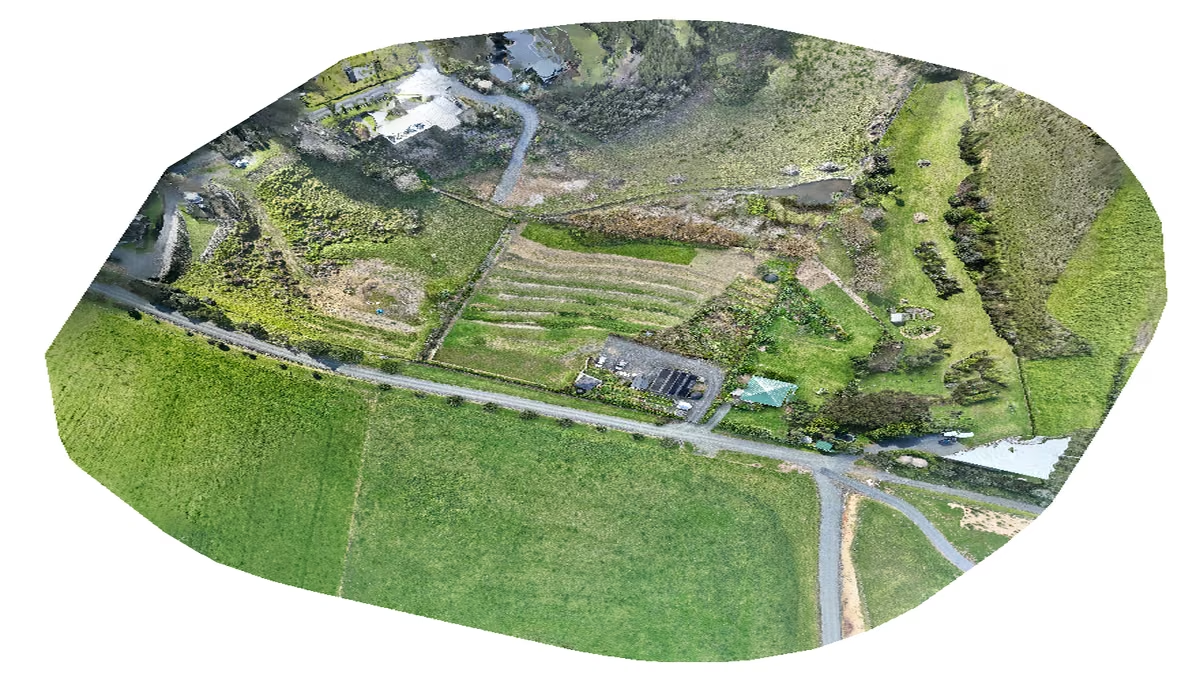
An Azure photogrammetry pipeline for less than two coffees
Phase 2 of my property digital twin turns 743 drone photos into maps and models on an Azure VM that exists as billable compute for about four hours a month.
AI checks every mission file before my drone flies
My consumer Mavic 3 has no SDK, so repeatable survey flights depend on mission files. An AI inspection caught unsafe defaults and a 22.88-metre altitude error before...
Discussion
Comments
Loading the discussion for this post.
Leave a comment
Your email stays private. If it matches a Gravatar account, your public avatar can appear after the comment is approved.