
Mark Smith
· 22 min read
What if every marae hosted a piece of the cloud?
A thought experiment in Māori data sovereignty: locally owned micro data centres that return skills, resilience, and a dividend to marae.
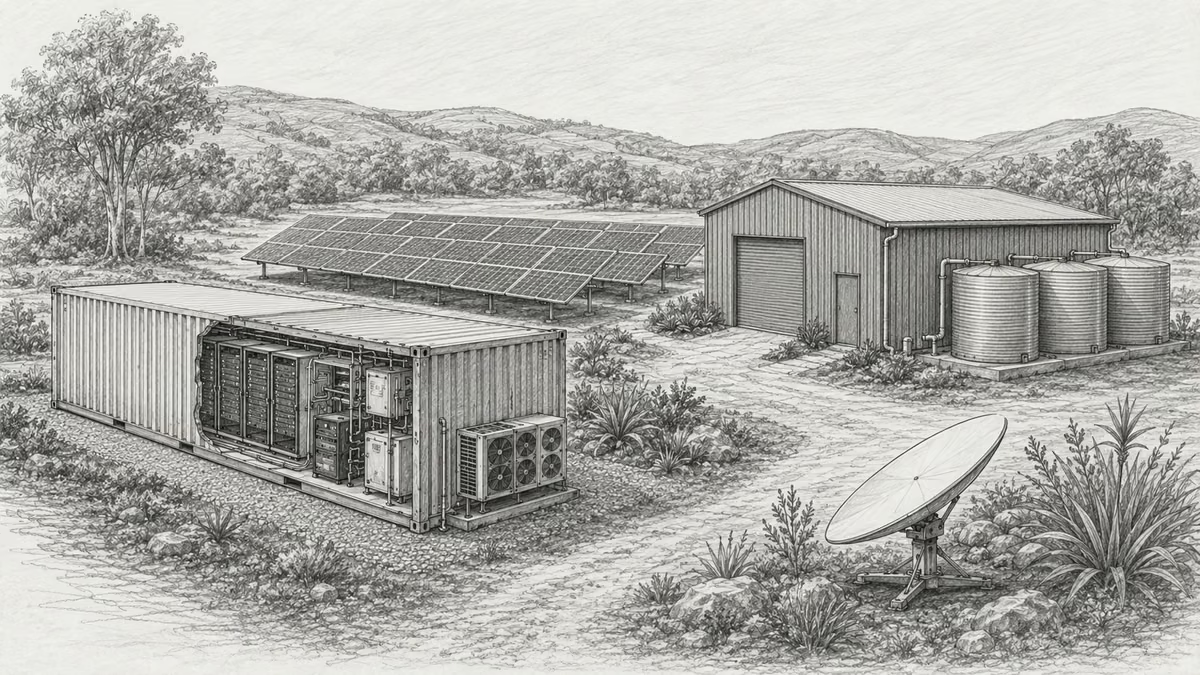
A thought experiment in Māori data sovereignty, self-sustaining communities, and building the Intelligence Age in Aotearoa on our own terms.
Key takeaway
- Data sovereignty depends on authority, governance, and ownership, not only where servers are located.
- A marae-owned network of modular data centres could return dividends, technical skills, energy resilience, and water resilience to participating communities.
- The technology already exists. The untested part is the ownership, governance, and commercial arrangement.
This morning I recorded a podcast interview with Amber Taylor, founder of Native Sentient, about her new working paper, From Principles to Practice: Māori Data Sovereignty at the Point of AI System Design. Somewhere in that conversation (the way the best ideas seem to arrive) a picture formed that I haven't been able to put down since. So I'm doing what I always do when an idea won't leave me alone: planting a flag in the sand and writing a blog about it.
One thing to flag before I do. The idea that follows is mine, not Amber's. Her paper is a careful, rigorous piece of work about how legitimate Māori authority can actually shape AI systems at the moment they're designed. It doesn't propose anything like what I'm about to describe, and I won't put words in her mouth. What her thinking did was light a fuse. Where it led is on me.
I am not going to build this. I don't want to own it, patent it, or turn it into a product. This is a thought piece, an invitation. If it resonates, I'd love to see the right people pick it up and carry it further than I ever could. Consider it a seed. Let's see how it grows.
Here's the seed.
What if every marae that wanted one could host a small, self-contained data centre (about the size of a shipping container) that kept Aotearoa's data on Aotearoa's soil, paid a dividend back to the marae, created skilled jobs for local people, and left the whole community more energy- and water-resilient than it found it?
Not a windowless warehouse on the edge of town, owned by an offshore giant. Something smaller, closer, and owned differently. A working piece of the Intelligence Age that belongs to the people whose whenua it sits on.
Sovereignty is bigger than a map#
When most people hear "data sovereignty," they picture a border. Keep the servers inside the country and you're done. But sit with anyone who has thought hard about Māori data sovereignty and you learn quickly that it is a much richer idea than a location on a map.
Te Mana Raraunga, the Māori Data Sovereignty Network formed in 2015, frames it around six principles: rangatiratanga (authority and control), whakapapa (relationships and context), whanaungatanga (obligations), kotahitanga (collective benefit), manaakitanga (reciprocity) and kaitiakitanga (guardianship). Their catch-cry says it plainly: "Our Data, Our Sovereignty, Our Future."
This is the heart of Amber's paper, and she puts it far better than I can. Her argument is that the decisive choices (which provider you use, where data is processed, what's retained, whose judgement stays human) are made at the point of design, long before anyone asks whether a system is "compliant." Those are governance decisions dressed up as engineering decisions. And she draws a sharp line between capability and mandate: technical skill, good intentions, even whakapapa, do not by themselves create the authority to use Māori data, language or knowledge. As she puts it, "capability is not mandate." Authority has to come from the particular people whose data, reo and mātauranga are involved.
Sit with that and "data sovereignty" stops being a question about which building the servers live in. It becomes a question about who holds the authority and who governs the decisions, and underneath that, who controls the infrastructure, because whoever controls the infrastructure ultimately holds power over everyone whose data flows through it.
Here's the wrinkle that makes this concrete. Even data physically stored in New Zealand by a company headquartered in the United States can still be reached under the US CLOUD Act, which lets American authorities compel access to data held by those companies wherever it sits in the world. Location helps. It isn't the whole story. As one New Zealand provider puts it, true sovereignty requires the absence of overseas legal reach, not merely the presence of a local postcode.
That's the gap I keep circling. If real sovereignty comes from ownership and governance, not just where the box lives, then the strongest possible answer isn't renting a slice of someone else's cloud region. It's owning the box, on your own land, governed by your own people.
Which brings me back to the marae.
The idea#
There are more than 770 tribal marae across Aotearoa, and over a thousand if you count urban and institutional ones. They are already the cultural, political and social heart of whānau, hapū and iwi: places built for gathering, guardianship and collective decision-making. In other words, the governance is already there. The mana is already there. The relationship to the whenua is already there.
So picture this. A marae that wants to take part hosts a micro data centre, a unit roughly the size of a 20- or 40-foot shipping container. It is:
- Built off-site and shipped in. Fully assembled, tested and configured in a factory, then delivered on the back of a truck and connected on site. Plug-and-play, not a construction project.
- Powered by its own solar array and batteries. Sized generously to run the unit and lift the whole marae (more on that below).
- Cooled without draining the community's water. Closed-loop and, where it makes sense, liquid or immersion cooling, topped up by rainwater catchment.
- Connected by fibre where it's close enough, or by satellite where it isn't.
- Geo-tagged and centrally orchestrated. Managed like any modern cloud region, so you get the reliability and tooling of a hyperscaler without needing a hyperscaler on site.
- AI-enabled. Storage and compute that can run modern workloads, close to where the data and the people are.
And the part that makes it more than infrastructure: the marae is a shareholder, not a landlord. This isn't land rented out for a fixed fee. The marae holds equity in the venture itself, so the return is an owner's dividend that grows with the network, not a flat rental cheque.
That's the whole idea. Now let me show you why almost none of it is science fiction, and then walk through the pieces that make it worth doing.
This isn't science fiction#
The "data centre in a box" is nearly twenty years old. Sun Microsystems shipped Project Blackbox back in 2006, a complete data centre with as many as 280 servers packed into a standard 20-foot container, needing only power, water and a network connection to run. Around the same time, Google was running a facility built from 45 containers supporting a 10-megawatt compute load. The Internet Archive migrated its digital collection into one of Sun's units.
The idea never went away; it got better. And crucially for this vision, Microsoft already makes exactly the thing I'm describing. The Azure Modular Datacenter (MDC) is a ruggedised data centre built into a 40-foot container, running Azure Stack Hub. Microsoft's own pitch for it names the use case directly: running workloads and controlling data for sovereignty purposes, in places where a conventional build isn't possible. It can run on generators where there's no grid, pair with satellite connectivity, and it can host hardware-accelerated machine learning at the edge. Change the framing from "defence deployment" to "community asset" and you have the beating heart of this idea, already engineered.
Fast forward to right now, and the modular data centre has become one of the hottest ideas in the whole Intelligence Age build-out. As hyperscale campuses strain power grids and take years to build, factory-built pods are being deployed in months: shipping-container-style units that support high-density AI workloads and, in the words of one recent write-up, "sovereign infrastructure closer to where data is created." HP built a multi-container AI pod containing 5,400 NVIDIA superchips that now powers one of Europe's fastest supercomputers, assembled in six months and switched on two days after it arrived on site. Crusoe now sells a turnkey, prefabricated "AI factory" that ships in as little as three months. There's a whole emerging category, "Container AIDC", of 20- and 40-foot ISO containers carrying 4 to 16-plus racks of GPU servers, delivered plug-and-play.
None of the ingredients are exotic. The container, the solar, the batteries, the cooling, the orchestration software, the AI hardware all exist and ship today. What doesn't exist yet is the arrangement: putting it on a marae, owning it locally, and wiring a community dividend into the model. That's the new idea. The rest is assembly.
Why Aotearoa, and why now#
The sovereign-data question isn't hypothetical here; it's being answered as we speak, and mostly on someone else's terms. Microsoft has been standing up its Azure New Zealand North region in Auckland, explicitly to give New Zealand organisations a local home for their data as the Privacy Act tightens. Amazon and Google are building here too.
The most striking detail, for this conversation, is who signed on first. Te Tumu Paeroa, the Office of the Māori Trustee, became an anchor tenant of Microsoft's New Zealand cloud region, guided by a pioneering Māori data sovereignty framework. So the principle is already proven: Māori data, in a Māori-governed arrangement, running on world-class infrastructure. What I'm proposing simply asks the next question: instead of Māori data travelling to a hyperscale campus in Auckland, what if a piece of the infrastructure travelled to the marae, and the community owned it?
This is the fork in the road. The default path of the Intelligence Age is centralisation: fewer, bigger facilities, further away, owned by fewer, larger players. There's a distributed path running right alongside it, and it's the one that actually fits a country of dispersed communities, strong local identity, and a genuine global lead in indigenous data sovereignty. We can either accept the centralised answer, or help write the distributed one.
Pillar one: a shareholder, not a landlord#
Start with the part that turns infrastructure into uplift, and the part that matters most to the whole argument. The marae isn't a landlord collecting rent for a patch of ground. It's a shareholder, holding real equity in the venture that owns and runs the unit.
That distinction is everything. A rental cheque is fixed and flat, and it leaves the value, the control and the decisions with someone else. Equity means the marae shares in the upside as the network grows, has a genuine say in how things run, and owns a piece of the thing itself. Ownership, not tenancy, is also what sovereignty looks like in practice: you can't govern what you merely rent.
If that sounds far-fetched, it's already happening in the energy world. Tesla's Virtual Power Plant (VPP) links thousands of home batteries into a single grid resource, and in 2024 it paid out $9.9 million to Powerwall owners who let their batteries support the grid. That's the exact shape of what I'm describing: the hosts own the asset, and the money flowing back is an owner's dividend, not a tenant's fee.
And the compute version of that model is arriving fast. Sunrun, Tesla and Renew Home have signed an agreement to aggregate more than 16 gigawatts of flexible capacity for hyperscalers and utilities. NVIDIA is working with a residential electrical-panel company to install compact AI compute nodes alongside home batteries, a vision one futurist summed up as "the neighbourhood becomes the data centre," where homeowners host a compute node and get paid for the capacity it provides. If a suburban garage can host a piece of the cloud and earn from it, a marae certainly can, at a scale that returns real value to the community rather than a few dollars to one household.
Call it a koha in reverse: the technology gives back to the people who own it.
Pillar two: kaitiaki, not fly-in contractors#
This is the pillar I care about most, so I'll be direct: infrastructure that lands on a community and is maintained by strangers who fly in and fly out is not uplift.
So the model has to include training local people to look after their own kit, both the physical facility and the technical infrastructure. Real skills, held locally, so the people who host the unit are also the kaitiaki who maintain it. A central management layer (the same kind of remote orchestration that lets a handful of engineers run an entire Azure region) means most day-to-day operation is automated and remote, but the hands-on guardianship, the eyes on the ground, the first response, and a genuine career pathway all stay on the marae.
I've spent my working life around the idea that skill beats knowledge, that what you can do matters more than what you can recite. This is that principle poured into concrete. A generation of rangatahi learning to run sovereign AI infrastructure, on their own whenua, is worth far more than the servers.
Pillar three: energy that lifts the whole marae#
Here's where the design gets generous on purpose. The solar array and batteries that power the unit shouldn't be sized just for the unit. They should be sized to power the entire marae.
A data centre is a steady, predictable, around-the-clock electrical load, which, counter-intuitively, makes it a fantastic anchor for a renewable energy system. You're already installing the panels, the batteries and the smart control to run the compute reliably. Oversize it, and the same system that keeps the servers humming also runs the wharenui, the wharekai, the lights, the hot water and the kitchen, and cuts or removes the marae's dependence on the grid and its power bills. When the compute demand dips, the marae draws on the surplus. The marae becomes energy self-sustaining, with the data centre as the reason the infrastructure got built in the first place.
I run solar and battery on my own place, so I'll say from experience: the moment a building generates and stores its own power, its relationship to the grid changes completely. Now imagine that for a marae: resilience through storms and outages, lower running costs, and independence, all arriving as a side effect of hosting the cloud.
Pillar four: water that lifts the whole marae#
Water is one of the first objections people raise about AI infrastructure. Most of the alarming water figures you've read come from two things: training frontier models, and old evaporative cooling running in hot, dry climates. Neither describes what we're talking about here. A marae node isn't training models; it's running them, serving the output of models that were trained somewhere else. That's a small fraction of the workload, and a small fraction of the resources that go with it.
On cooling, the technology has moved fast. Modern data centres increasingly use sealed, closed-loop systems that are filled once at commissioning and then recirculate the same water indefinitely, with no evaporation; Microsoft's latest designs use exactly this approach to remove cooling water entirely and have pushed water-use effectiveness down to 0.30 litres per kilowatt-hour. Immersion cooling, where the servers sit in a non-conductive fluid, can also remove water from the server-cooling loop. And New Zealand's cool, maritime climate is close to ideal for free-air and dry cooling; we don't have the desert-heat problem that drives so much water use overseas. Add it up and a closed-loop node here uses water once to fill the loop, then next to nothing.
It helps to hold that "next to nothing" up against the everyday things nobody thinks twice about. A typical sit-down restaurant gets through around 5,800 gallons of water a day, roughly 22,000 litres, most of it on dishwashing and restrooms. An 18-hole golf course commonly uses hundreds of thousands of gallons a day, and well over a million in a dry summer. It takes about 1.1 gallons of water to grow a single almond, so a small handful of them can represent more water than a recirculating node uses in a day. And a New Zealand dairy shed runs on roughly 70 litres per cow per day for washdown, plus about the same again for the cows to drink; a herd of a few hundred cows gets through tens of thousands of litres a day, before a drop of irrigation. Set against any of these, a sealed box of servers barely registers.
So the water story doesn't just survive scrutiny, it flips. Because the node needs so little, the rainwater catchment we build to serve it can be sized, like the solar, to serve the whole marae. The same tanks that top up the cooling loop give the community water resilience through dry spells and supply interruptions. Once again, the marae ends up better off than it started, and the data centre is the reason the tanks got put in.
Pillar five: it has to belong to the place#
None of this works if the result is an ugly steel box scarring the whenua. That would be a betrayal of the whole idea.
So aesthetics and environmental fit aren't a nice-to-have; they're a design requirement equal to any other. The unit should be clad, landscaped and planted so it reads as part of the place, not an intrusion on it. Low visual footprint. Sympathetic to its surroundings. Something a community can be proud to stand near, not something they apologise for. If we can put beautiful buildings on marae, we can make a piece of infrastructure that belongs there too.
The test is simple: does it uplift the marae, or does it diminish it? If the answer is ever the second, the design isn't finished.
The connectivity question#
The hardest practical piece is getting the data in and out.
New Zealand's backbone is strong. Internationally we're carried by submarine cables like the Southern Cross network (whose NEXT cable added around 72 terabits per second of capacity between Sydney, Auckland and Los Angeles), alongside Hawaiki and Tasman Global Access. Domestically, our fibre network reaches a great deal of the country. Where a marae sits close to that fibre, connecting it is straightforward.
The interesting question is the marae that sit beyond easy reach of fibre. Starlink service is available across New Zealand. I was one of the first in New Zealand to get Starlink myself, since I live a good 40 minutes from the nearest town. As the low-Earth-orbit constellations add satellite-to-satellite laser links and ever-higher-capacity service tiers, it's entirely plausible that a satellite uplink alone could feed a container of this size at a remote marae, no trench required.
And there's a second trend working in our favour: AI models are becoming more efficient. Lower-power inference reduces the power and cooling each site needs, which improves the case for small, solar-powered distributed compute. The exact workload still matters. A node serving storage or modest inference is a different engineering proposition from one training a frontier model.
Yes, there's genuine scarcity in the world's supply of AI silicon right now. But scarcity is an argument for using it wisely and distributing it fairly, not an argument for hoarding it in a handful of mega-campuses.
The network is the backup: three copies, one motu#
There's one more question any serious person will ask about small, distributed sites: what happens when one fails? A container catches fire. A river floods. A drive dies. Isn't scattering data across dozens of little sites riskier than keeping it in one hardened fortress?
It's the opposite, and understanding why is the key to the whole architecture.
The oldest rule in data protection is the 3-2-1 rule: keep three copies of your data, on two different kinds of storage, with at least one copy offsite. A photographer named Peter Krogh formalised it back in 2009, and it's now the baseline endorsed by agencies like the US Cybersecurity and Infrastructure Security Agency and reflected in the NIST Cybersecurity Framework. The logic is simple and unforgiving: no single event (a failed disk, a fire, a flood, a break-in, a ransomware hit) should ever be able to wipe out every copy at once.
The "one offsite" copy is the part that matters most here, because it has to be far enough away to survive a regional disaster, rather than only a bad drive. In a country that sits on a plate boundary and knows a thing or two about earthquakes, floods and storms, "offsite" has to mean genuinely elsewhere. The hardened modern version, sometimes written 3-2-1-1-0, goes further again: it adds an immutable or air-gapped copy that an attacker can't delete without detection, and it insists you actually test that your backups restore.
Here is where a network of marae data centres turns its supposed weakness into its single greatest strength. One central data centre is one point of failure: everything in one place, one fire or flood away from catastrophe. A distributed mesh of small nodes spread across the motu is the reverse: geographic separation built directly into the architecture.
Picture how an iwi's data could be held. The working copy lives on their own marae's node, close to home and under their own hand. A second, geographically separated copy is mirrored to a partner marae's node at the far end of the country. Think Te Tai Tokerau to Murihiku: over a thousand kilometres away, on a different fault line, under a different weather system, on a different power grid. A third, immutable copy sits on different storage again, perhaps at a national sovereign-archive node. That satisfies 3-2-1 completely, and every single copy stays in Aotearoa, on community-owned, Māori-governed infrastructure. Nothing has to leave the country to be safe.
That's the payoff of the distributed model. You no longer have to choose between "keep it sovereign" and "keep it safe." The redundancy is sovereign. Your disaster recovery doesn't route your most precious data through some offshore provider's cloud region; it routes it to another marae.
And this protects against something deeper than a dead drive. Remember Amber's point that organisational change is itself a governance event, that data handed over inside one relationship can resurface as an asset in a completely different transaction. She uses the 2025 bankruptcy and sale of the genetic-testing company 23andMe as the cautionary tale: information people gave for one purpose becoming something to be sold when the company changed hands. Sovereign redundancy across marae guards against that too. When the infrastructure is owned by the community and every copy stays in Māori-governed hands, there is no offshore provider to be acquired, no foreign jurisdiction that can reach in, no bankruptcy court in another country deciding the fate of your whakapapa. The model protects the data from being lost and from being taken.
An idea an island nation can lead#
I think Aotearoa is unusually well-placed to be first at this. We're an island nation of dispersed communities, we have a deep cultural infrastructure of marae already in place, and (through Te Mana Raraunga, work like the Te Tumu Paeroa framework, and researchers and practitioners like Amber) we are genuinely a global leader in indigenous data sovereignty. The pieces line up here in a way they don't in many places.
But the beauty of the model is that it isn't ours alone. The same thinking (locally-owned, community-governed, self-sustaining micro data centres) could serve First Nations communities in Canada, Aboriginal and Torres Strait Islander communities in Australia, and rural and remote communities anywhere in the world that wants to keep its data, its dividends and its skills at home. If Aotearoa builds the template, the template travels.
That's the kind of thing a small country can be known for: not the biggest data centre, but the best idea about who a data centre should belong to.
Planting the flag#
For this to become real, it needs things I can't supply on my own: a platform and a way to actually purchase and deploy the units; a cloud partner operating at genuine scale to provide the orchestration and the software backbone; iwi and hapū leadership to shape it on their own terms, because, as Amber's paper insists, legitimate authority has to come from the rights-holders themselves, not from anyone designing at them; and investment from people who can see that infrastructure which returns a dividend, builds skills, and leaves communities more resilient is worth backing.
If any of that lights you up (if you're an iwi leader, a technologist, an investor, a policymaker, or just someone who thinks this is worth chewing on), I'd love to talk. Not because I want to run it, but because I want to see it run.
Our data. Our whenua. Our Intelligence Age. Let's build it on our own terms.
Kia ora to Amber Taylor for the kōrero that sparked this. If it sparked something in you too, pass it on.
Mark Smith is Principal AI Strategist at Cloverbase. To discuss this article or work with me, contact me at Cloverbase.

Mark Smith
Principal AI Counsel · Microsoft AI MVP
Helping people build practical AI skill in the Intelligence Age.
More from nz365guy
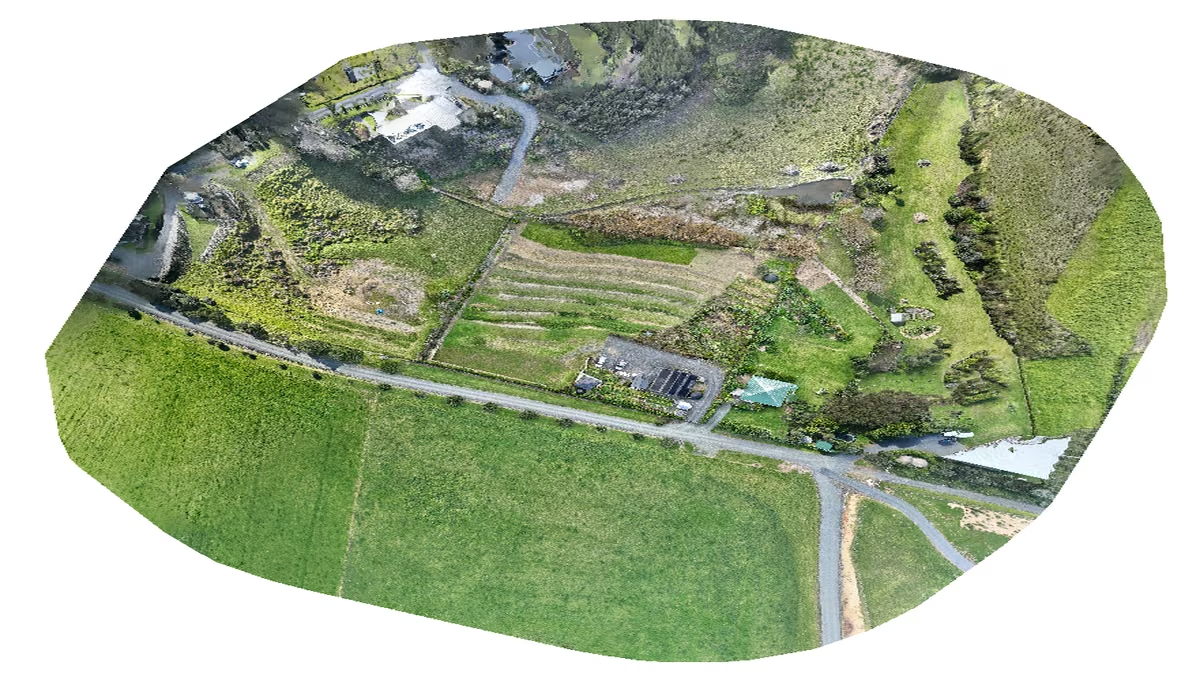
An Azure photogrammetry pipeline for less than two coffees
Phase 2 of my property digital twin turns 743 drone photos into maps and models on an Azure VM that exists as billable compute for about four hours a month.
AI checks every mission file before my drone flies
My consumer Mavic 3 has no SDK, so repeatable survey flights depend on mission files. An AI inspection caught unsafe defaults and a 22.88-metre altitude error before...

Why I started NZ Ledger as open financial infrastructure
NZ Ledger is my plan for open-source financial infrastructure designed for people, AI agents, and New Zealand businesses.
Discussion
Comments
Loading the discussion for this post.
Leave a comment
Your email stays private. If it matches a Gravatar account, your public avatar can appear after the comment is approved.