
Mark Smith
· 5 min read
Why I started NZ Ledger as open financial infrastructure
NZ Ledger is my plan for open-source financial infrastructure designed for people, AI agents, and New Zealand businesses.

Rising accounting software costs started this as a question about my own business. It ended with a public plan for open financial infrastructure designed for people, agents, and New Zealand business.
Key takeaway#
Key takeaway
- NZ Ledger will be open source, self-hostable, and designed for people and agents.
- A deterministic, double-entry accounting kernel will keep financial truth controlled and auditable.
- I will keep developing it around real business needs, and the community is invited to help shape and build it.
The question that started it#
For years, we have used mainstream accounting software to run our two-person business. It worked, but the price kept climbing while much of the product remained irrelevant to how we operate.
My wife runs our accounts. Whenever she visited the provider's website to log in, she saw attractive pricing for new customers that bore little resemblance to what we were paying. She found that deeply offensive. The message seemed to be that loyalty was worth less than acquisition.
Then I saw several LinkedIn posts from other business owners expressing the same frustration. Those posts were the straw that broke the camel's back.
I came back to a question I have been asking about every software subscription:
Can we build a better option?
The problem is bigger than one subscription#
Most accounting software is still designed around a person working through forms, menus, and reconciliation screens. That is not how I think business software will work in the years ahead.
Artificial intelligence (AI) agents will increasingly collect evidence, match transactions, prepare journals, reconcile accounts, explain variances, and complete routine work. People will remain responsible for material decisions, unusual transactions, approvals, and judgement.
That changes the design.
An agent should not imitate a person clicking through a website. A person should not review hundreds of routine transactions that deterministic rules can validate safely.
Both should operate through the same controlled system, with clear identity, authority, evidence, limits, and audit history.
A trusted core before an application#
The foundation of NZ Ledger is a deterministic, double-entry accounting kernel.
Posted journals cannot be edited or deleted. Corrections use reversing or adjusting entries. Every number should be traceable from a report, through the ledger, back to its source evidence and governing policy.
The rules come first.
AI can propose a treatment and act autonomously inside an explicit mandate. It cannot bypass ledger rules, invent an exchange rate, alter a closed period, or write directly into storage.
Probabilistic systems can help with interpretation. Financial truth must remain deterministic.
Built for New Zealand, not just my business#
My business is a useful first test, but it is not the boundary.
NZ Ledger is intended to underpin complete financial software for the broad range of New Zealand organisations served by mainstream business accounting platforms.
Versioned New Zealand policy packs can cover goods and services tax (GST), reporting, tax treatment, evidence, and period close. Industry capabilities such as construction job costing, inventory, property, agriculture, and hospitality can sit above the core as modules or integrations.
Multicurrency and emerging financial instruments also need to be foundational. Stable-value digital assets bring distinct questions about custody, valuation, fees, networks, and tax treatment. Those concerns cannot be safely bolted on later.
Open source and deployed on your infrastructure#
NZ Ledger is not intended to become another centrally controlled software as a service (SaaS) subscription.
The architecture is designed so organisations can deploy it to infrastructure they control, including their own cloud or private hosting. Ownership, data portability, extension points, and complete exportability therefore matter from the beginning.
Control matters.
Developers should be able to build connectors, industry modules, reports, alternative interfaces, and specialised agents without weakening the accounting core.
There is no marketplace today, but the architecture must not prevent an ecosystem tomorrow.
The repository is public#
I have published the public home for NZ Ledger:
There is no finished accounting application in it. That is deliberate.
The repository establishes the mission, architecture, governance, security model, extension boundaries, and community backlog.
I will continue working on it in response to the real needs of my business. But this should not become a personal project built behind closed doors. The goal is a credible open-source financial option for New Zealand, shaped by developers, accountants, business owners, security specialists, and anyone else willing to contribute.
What began as frustration with pricing has become a larger question:
What would financial infrastructure look like if we designed it today for people, agents, new forms of money, and the New Zealand businesses that will depend on it?
NZ Ledger is our opportunity to find out.
Mark Smith is Principal AI Strategist at Cloverbase. To discuss this article or work with me, contact me at Cloverbase.

Mark Smith
Principal AI Counsel · Microsoft AI MVP
Helping people build practical AI skill in the Intelligence Age.
More from nz365guy
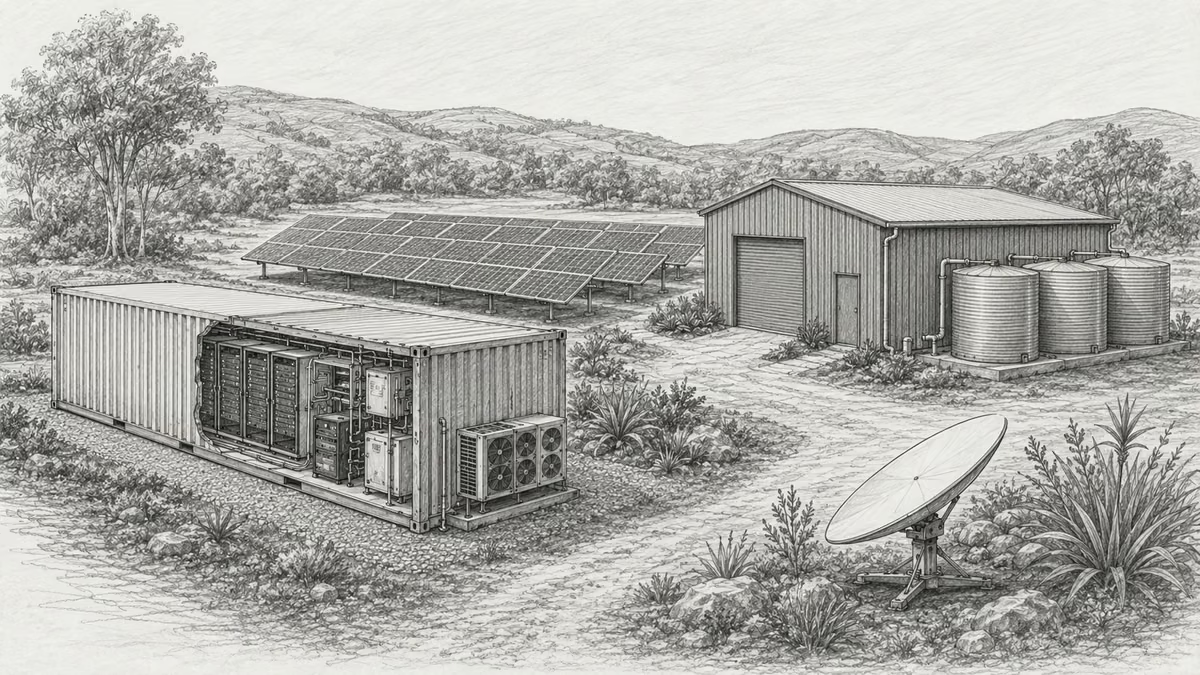
What if every marae hosted a piece of the cloud?
A thought experiment in Māori data sovereignty: locally owned micro data centres that return skills, resilience, and a dividend to marae.
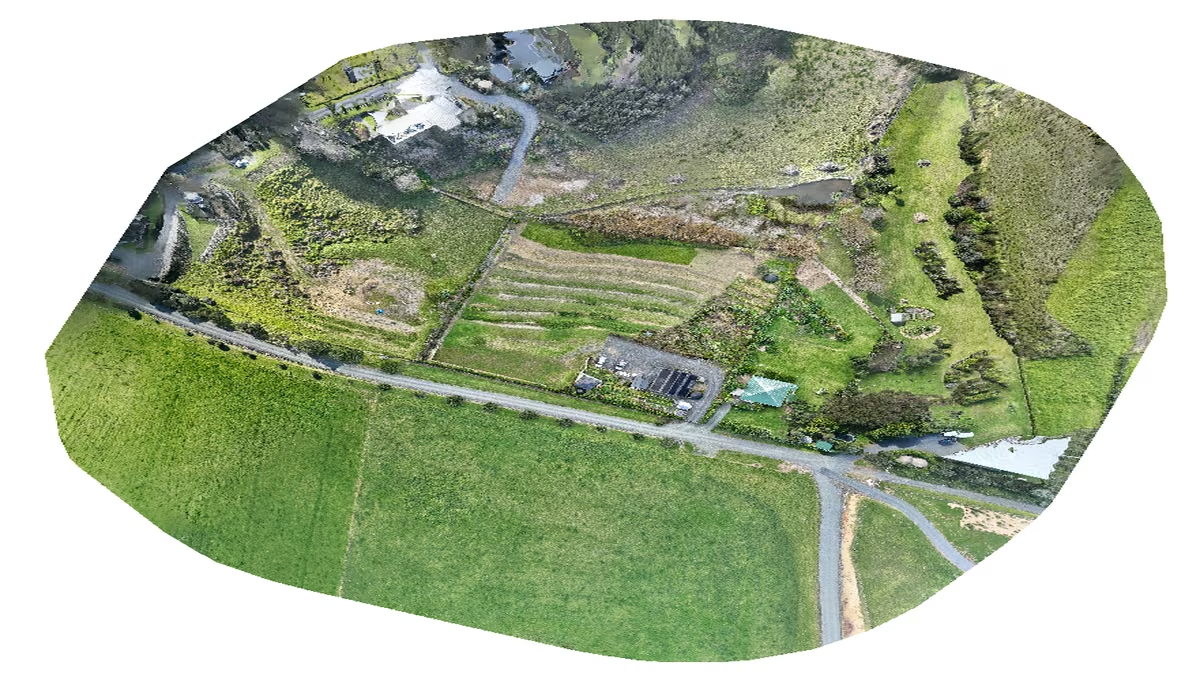
An Azure photogrammetry pipeline for less than two coffees
Phase 2 of my property digital twin turns 743 drone photos into maps and models on an Azure VM that exists as billable compute for about four hours a month.
AI checks every mission file before my drone flies
My consumer Mavic 3 has no SDK, so repeatable survey flights depend on mission files. An AI inspection caught unsafe defaults and a 22.88-metre altitude error before...
Discussion
Comments
Loading the discussion for this post.
Leave a comment
Your email stays private. If it matches a Gravatar account, your public avatar can appear after the comment is approved.