
Mark Smith
· 8 min read
Can I Build This? The Question That Saved Me $10,000 a Year in SaaS Subscriptions
A Speechify renewal email made me question every subscription my business pays for. Since January 2026, I have eliminated nearly $10,000 in annual SaaS costs by...
Key takeaway
- Before renewing any SaaS subscription, ask one question: can I build this myself with AI assistance?
- Dark patterns around cancellation - particularly Stripe configurations that make leaving deliberately painful - are eroding customer trust faster than the products create value
- Since January 2026, I have eliminated nearly $10,000 in annual subscriptions from my business without losing any capability
Last week I received a renewal notice from Speechify. It is a text-to-speech tool - you point it at a webpage, it reads the content aloud. As a dyslexic, I use this kind of tool daily. Hearing text while seeing it highlighted on screen is not a nice-to-have for me. It is how I process written content effectively.
But before I clicked renew, I asked myself a question I have been asking since January: can I build this?
Four hours later I had a working Chrome extension. It extracts article text from any webpage, reads it aloud using Chrome’s built-in speech engine, highlights each sentence as it is spoken, auto-scrolls to follow along, and lets me adjust the speed anywhere from 0.5x to 3x. I default to 2x. It cost me nothing. No API (Application Programming Interface) key. No subscription. No account.
That is one more subscription gone.
The Question That Changed Everything#
The question - can I build this? - sounds simple. Even six months ago the answer was almost always no. Building a text-to-speech Chrome extension from scratch would have taken a developer days of work and meaningful expertise in browser extension architecture, the Web Speech API (Application Programming Interface), DOM (Document Object Model) manipulation, and content extraction heuristics. I would have paid someone to build it, and the cost would have exceeded several years of Speechify subscriptions.
Today, with AI assistance, I built it in a single conversation. Not a proof of concept. A working tool with a popup interface, keyboard shortcuts, voice selection, speed controls, and intelligent article extraction that strips navigation, ads, and footers before reading.
It changes what developers can do and impacts the economic calculation for every SaaS (Software as a Service) subscription in your business.
The Subscription Graveyard#
Speechify is not the first tool I have replaced. Since January, applying this same question systematically, I have eliminated:
- LinkedIn Sales Navigator - I built my own signal-based CRM (Customer Relationship Management) that tracks the buying signals I actually care about, without LinkedIn’s walled garden or their aggressive upselling.
- Adobe Creative Cloud - For the specific tasks I was using it for, AI-powered alternatives and purpose-built tools handle the work at a fraction of the cost.
- Multiple Power Apps licences - I replaced several internal tools with lightweight applications my AI agents build and maintain.
- Bit.ly - URL shortening is a solved problem that does not require a monthly subscription.
- Four social media management tools - consolidated into workflows my agents handle directly.
- Two websites - rebuilt on modern stacks I control, with two more migrations in progress.
The total is approaching $10,000 in annual subscriptions removed from my business. Not by going without the capabilities. By building them.
The Dark Pattern Problem. Eliminating subscriptions taught me something uncomfortable about the SaaS industry: many companies have optimised for making it hard to leave rather than making it compelling to stay.#
A pattern I have seen repeatedly involves Stripe, the payment gateway. Stripe itself is excellent infrastructure. But Stripe offers configuration options that vendors use to make cancellation deliberately painful. Buried unsubscribe flows. Multiple confirmation screens. Offers and counter-offers and “are you sure” dialogs designed to create friction. The technical term is a dark pattern. The plain English term is that these companies do not trust their product to retain you on merit.
I want to be clear: this is not Stripe’s fault. Stripe provides tools. Vendors choose how to configure them. But the pattern is widespread enough that encountering it has become a reliable signal. When a company makes it harder to leave than it was to join, they are telling you something about how they view the relationship.
The X Story#
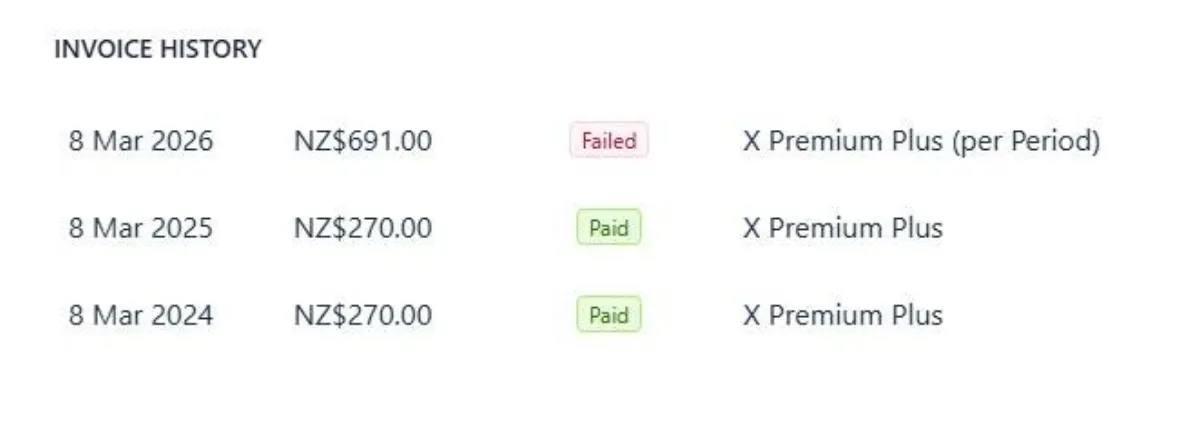
The most egregious example I have experienced is X, formerly Twitter. After two years as a paying subscriber, my renewal fee jumped from $270 to $691. No warning. No explanation of what additional value justified a 156 percent increase.
When I decided not to renew, X attempted to charge my card twelve times. Not once. Not twice. Twelve separate attempts, at random intervals, with no mechanism to opt out through the platform. I had to contact my bank and freeze the transaction to prevent the charge going through.
Twelve attempts to take money from a customer who has said no. That is not a billing retry policy. That is hostile.
If I had not been proactive with my bank, I would have been charged $691 for features I do not need and did not agree to at that price. This experience did more to erode my trust in subscription software than any competitor ever could.
The Build-or-Buy Calculation Has Changed#
The traditional build-or-buy framework weighs development cost against subscription cost over time, factoring in maintenance burden, opportunity cost, and the value of focusing on your core business rather than reinventing tools.
AI has shifted every variable in that equation.
Development cost has dropped dramatically. What took days now takes hours. What took hours now takes minutes. A Chrome extension that would have been a multi-day project became a single conversation.
Maintenance burden has shrunk. AI-assisted codebases tend to be clean, well-documented, and straightforward to modify. When I need to change my text-to-speech extension - add a new feature, fix an edge case - the same AI that built it can modify it.
The opportunity cost argument has weakened. If building a replacement takes less time than researching, evaluating, and onboarding a new SaaS tool, building is no longer the expensive option.
What has not changed is the importance of knowing which tools are worth building and which are not. I am not going to build my own email server. I am not replacing GitHub. I am not writing a payment processor. Infrastructure with genuine network effects, deep compliance requirements, or massive ongoing investment in reliability - those subscriptions earn their keep.
But a tool that reads a webpage aloud? A URL shortener? A social media scheduler? These are features, not platforms. And features are exactly what AI is best at building.
How I Approach the Decision#
Every time a renewal comes up, I run through three questions:
- Is this tool a feature or a platform? A feature does one or two things I need. A platform provides infrastructure, network effects, or ecosystem access I cannot replicate. Features are candidates for replacement. Platforms usually are not.
- Could I build a replacement in a single session? If the answer is yes, I build it before renewing. If the answer is “maybe, with a couple of days,” I evaluate whether the subscription cost justifies not trying. If the answer is clearly no, I renew.
- Does the vendor respect my decision to leave? This sounds like a soft factor, but it has become a hard filter. If cancelling requires navigating dark patterns, or if the company’s billing practices are aggressive, that tells me the relationship is transactional in the worst sense. I prioritise replacing those subscriptions first.
The Bigger Picture#
I run a 23-agent AI operating system for my business. These agents handle marketing, finance, legal review, product development, and operations. They coordinate through an orchestrator called Rook, reason with multiple language models, and operate continuously on cloud infrastructure.
This system - which I have written about extensively - is the engine that makes the “can I build this” question practical rather than aspirational. When I decided to replace Speechify, I did not open a code editor and start from scratch. I described what I needed, the AI built it, and I tested it. The whole process, from the moment I asked the question to having a working extension in my browser, was a single sitting.
Six months ago, that would have sounded like science fiction. Today it is a Tuesday.
What This Means for You#
You do not need a 23-agent AI system to start asking this question. You need a conversation with Claude, DeepSeek AI, Moonshot AI, ChatGPT, or any capable AI assistant. Pick your most expensive subscription that does something relatively simple. Describe what it does. Ask the AI to build a replacement. You might be surprised.
Not every subscription will be replaceable. Some will be worth every cent. But I would wager that most businesses are paying for at least a few tools that have become features - and features that AI can now build in an afternoon.
The subscription economy has spent a decade training us to pay monthly for capabilities we use daily. AI is giving us the option to own those capabilities instead. That is not a threat to every SaaS company. But it is a question every SaaS customer should be asking.
Can I build this?
Increasngly, the answer is yes.
Mark Smith is the founder of Cloverbase, an AI strategy consultancy based in Whangārei Heads, New Zealand.

Mark Smith
Principal AI Counsel · Microsoft AI MVP
Helping people build practical AI skill in the Intelligence Age.
More from nz365guy

What if every marae hosted a piece of the cloud?
A thought experiment in Māori data sovereignty: locally owned micro data centres that return skills, resilience, and a dividend to marae.
An Azure photogrammetry pipeline for less than two coffees
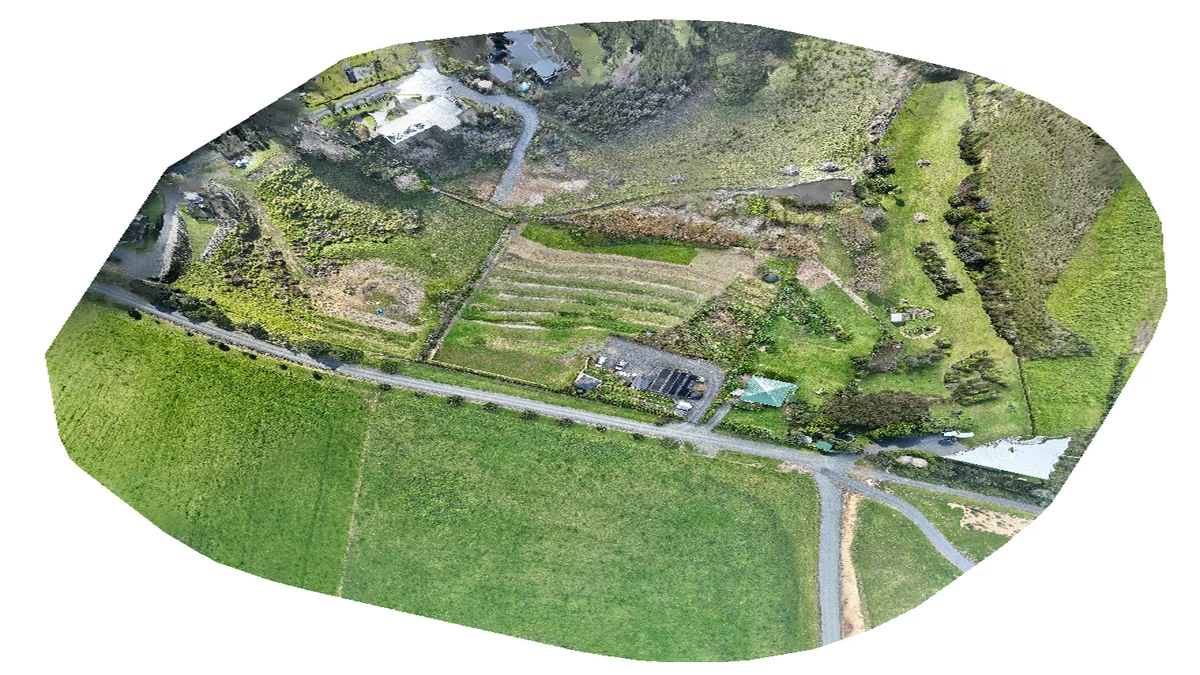
Phase 2 of my property digital twin turns 743 drone photos into maps and models on an Azure VM that exists as billable compute for about four hours a month.

AI checks every mission file before my drone flies
My consumer Mavic 3 has no SDK, so repeatable survey flights depend on mission files. An AI inspection caught unsafe defaults and a 22.88-metre altitude error before...
Discussion
Comments
Loading the discussion for this post.
Leave a comment
Your email stays private. If it matches a Gravatar account, your public avatar can appear after the comment is approved.