
Mark Smith
· 14 min read
The Microsoft Innovation Podcast: A Nine-Year Wrap
After 836 episodes across seven shows and nearly a decade, I'm wrapping up the Microsoft Innovation Podcast. Here's what the numbers say, what the stats don't...
On 28 August 2017, I hit publish on a podcast episode for the first time. The guest was Guus Krabbenborg, a Dutch advisor I respected enormously. The show was called The Dynamics 365 Show. I had no producer, no schedule, no idea what I was doing.
Today, almost nine years later, I'm wrapping it up.
This is the long version of why, and what those nine years actually looked like.
A note that was stuck to my monitor#
I started this podcast for one reason: I wanted to learn how to listen.
For most of my career up to that point, I'd been the person in the room with the ideas. The advisor. The one doing the talking. And somewhere along the way, I'd realised that telling is easy and listening is hard - and I was good at the wrong one.
There was a Post-it note stuck to my monitor for years. It said: "Ask the question, and then shut the fuck up."
That was the brief. Not a media empire. Not a brand. A discipline.
Three people in particular had shown me what good looked like. Joel Lindstrom had written blog posts on podcasting that I read end-to-end. Gus Gonzalez and George Doubinski were doing it at a level I admired. I read everything Joel had written, took a LinkedIn Learning course on podcasting, and then committed to one year - twenty-six episodes. That number wasn't ambitious. It was honest. I sat down with a sheet of paper and worked out if I knew twenty-six people I could interview, and I almost ran out before I was finished counting.
I recorded the first four episodes before I published any of them, just so I'd have a buffer to learn audio editing in.
I never imagined the buffer would last nine years.
The arc, in three names#
The show has carried three names. Each rebrand happened because Microsoft pivoted - and the discipline was always to stay current to where the audience was actually heading.
The Dynamics 365 Show (2017) was about CRM specifically. That was the world I lived in.
The Microsoft Business Applications Podcast came when Microsoft turned Dynamics 365 into a suite of around thirty applications. Calling it the Dynamics 365 Show no longer reflected what the audience cared about.
The Microsoft Innovation Podcast is the current name. It came when I realised I was doing far more work in AI and Copilot, and the previous name didn't have room for it. Innovation gave me permission to follow the technology wherever Microsoft pushed it.
Same show. Same mission. Three names that each tracked a real industry shift.
Why one feed became seven shows#
The MVP Show was the second show I launched, and it changed everything for me.
I wanted to demolish the idea that Microsoft MVPs were some elite caste. They aren't. They come from every walk of life, every culture, every imaginable starting point. I wanted listeners to hear those stories and think, "hang on - if they can do this, maybe I could too." That was the entire editorial thesis.
From there, the show-within-a-show pattern became my default. Whenever I noticed a category was underrepresented - or a part of the Microsoft world wasn't being heard from - I'd spin up a new show inside the same feed. The cross-pollination was the point. Someone tuning in for MVP stories would find Microsoft FTE insider conversations one day. Someone there for Power Platform deep-dives would discover the Ecosystems Show panel.
The lineup, with episode counts as I write this:
- The MVP Show - 400 - MVPs from every continent, every background
- The Power Platform Show - 198 - the underlying technology of so much of Dynamics 365
- The Power 365 Show - 103 - originally the Microsoft FTE / insider show
- The Ecosystems Show - 51 - five-person panel format, video plus audio
- The Copilot Show - 37 - the current home for Microsoft FTE conversations
- The AI Unfiltered Show - 29 - practical AI, no theory
- The AI Advantage Show - 24 - applied AI
The Ecosystems Show is worth its own paragraph. It's the only one with a panel format - me, Andrew Welsh, Chris Huntingford, Ana Welsh, and Will Dorrington. Five people, video plus audio, heavy riffing. It taught me a completely different way to podcast. After years of one-on-one interviews where my job was to disappear into the questions, suddenly I was sharing a room with four other strong personalities and the whole rhythm changed. I loved it.
What the numbers actually say#
I've never been a person who chases vanity metrics. But when you wrap something up after nine years, the numbers do tell a story.
Lifetime: Half a million downloads across 836 published episodes, distributed to listeners in 188 countries and territories and 9,891 unique cities.
Geographic breakdown - all time:
- United States - 116,861 (32%)
- United Kingdom - 81,577 (22%)
- Australia - 24,354 (6%)
- Canada - 21,690 (6%)
- Germany - 18,504 (5%)
- Sweden - 7,522 (2%)
- New Zealand - 6,591 (1%)
- India - 6,067 (1%)
- Japan - 5,357 (1%)
- Belgium - 5,280 (1%)
By continent: Europe 42%, North America 39%, Oceania 8%, Asia 6%, Africa 1%, South America under 1%.
By city, the top seven: London 29,549, Glasgow 7,297, Sydney 6,759, Melbourne 5,914, Atlanta 5,624, Caterham 5,552, Islington 4,447. London alone accounts for 8% of every download the show has ever had.
How people listen: Apple Podcasts 41% (147,464), Apple iTunes 12% (46,549), Spotify 10% (37,073), web browser 8% (30,206), Overcast 6% (22,642). The long tail runs through Castbox, Podcast Addict, Google Podcasts, Pocket Casts, Stitcher, Audible, iHeartRadio, Player FM, Snipd, and roughly twenty more apps I'd never heard of when I started.
On what device: iPhone 56% (203,264), Windows 19% (68,345), Android phone 14% (51,936), Apple computer 2%. Mobile listening accounts for 71% of every download.
The five most-downloaded episodes of all time:
- Integration of PowerApps and Power Automate with Microsoft Teams with Stuart Ridout - 1,224
- RPA in Power Automate with Ashvini Sharma - 1,138
- Daniel Christian on the MVP Show - 1,133
- PowerApps Component Framework with Greg Hurlman - 1,129
- Power Apps Interface Design with Barry Ferguson - 1,127
(Buzzsprout's stats note that 134,511 of the lifetime downloads were manually added during a host migration and are not IAB-certified - so the real "machine-counted" figure is around 358K. I'm including the full number because it's the honest total of everything the show has reached.)
The cost of podcasting for me#
Running a podcast at this cadence isn't free. By the most recent year, the show was costing me around 30,000 dollars annually in hard out-of-pocket spend - editors, scheduling, graphics, audio engineering, hosting. None of that counts the time. It is genuinely expensive to do this well.
Which brings me to a story I've never written about publicly.
A few years ago, a company reached out and offered to "grow my numbers" for a fee. Social media, advertising, the works. I signed up. Within a week, my downloads jumped ten to fifteen times. I was thrilled - for about another week, until I started looking at the data.
It was a bot farm. Pure vanity metrics. I was paying for clicks that no human ever heard.
I cut it the moment I worked it out. And ever since - for three years now - I've been hit up roughly weekly by people offering to "promote" the podcast. About 99.99% of the inbound has come from one country. Bangladesh. I've stopped counting.
The lesson stuck. Real growth comes from real value to real listeners. If you can't tell the difference between an audience and a download counter, you've already lost.
What the stats don't show#
There are guests on this show who are no longer with us.
I've had family members reach out and ask if they could have a copy of an episode - to remember a parent or a partner by, in their own voice, talking about something they loved. There is no podcast metric for that. It is one of the most humbling things that has ever happened to me, and it's reframed how I think about the entire body of work.
Eight hundred-plus episodes is also eight hundred-plus voices preserved.
The people I had access to because of this microphone#
The single biggest unexpected gift of running this podcast has been the access.
I've had genuine conversations with people I would almost certainly never have met otherwise. James Phillips - who took the Microsoft business applications suite and turned it into a multi-billion-dollar business - was one of them. Charles Lamanna, Ryan Cunningham, Steven Siciliano - leaders who were shaping Power Platform and Dynamics 365 from the inside. I got to ask them questions. I got to hear their thinking before it became the marketing.
That access didn't come from being important. It came from having a microphone, asking good questions, and showing up consistently for nearly a decade.
I refined who I said yes to over time. I learned to say no to guests who were just running a marketing exercise dressed up as an interview. I became wary, even, of senior people from Microsoft who came on with nothing to say beyond the current talk track. The audience could tell. So could I.
The filter sharpened. The signal got cleaner.
How the engine actually ran#
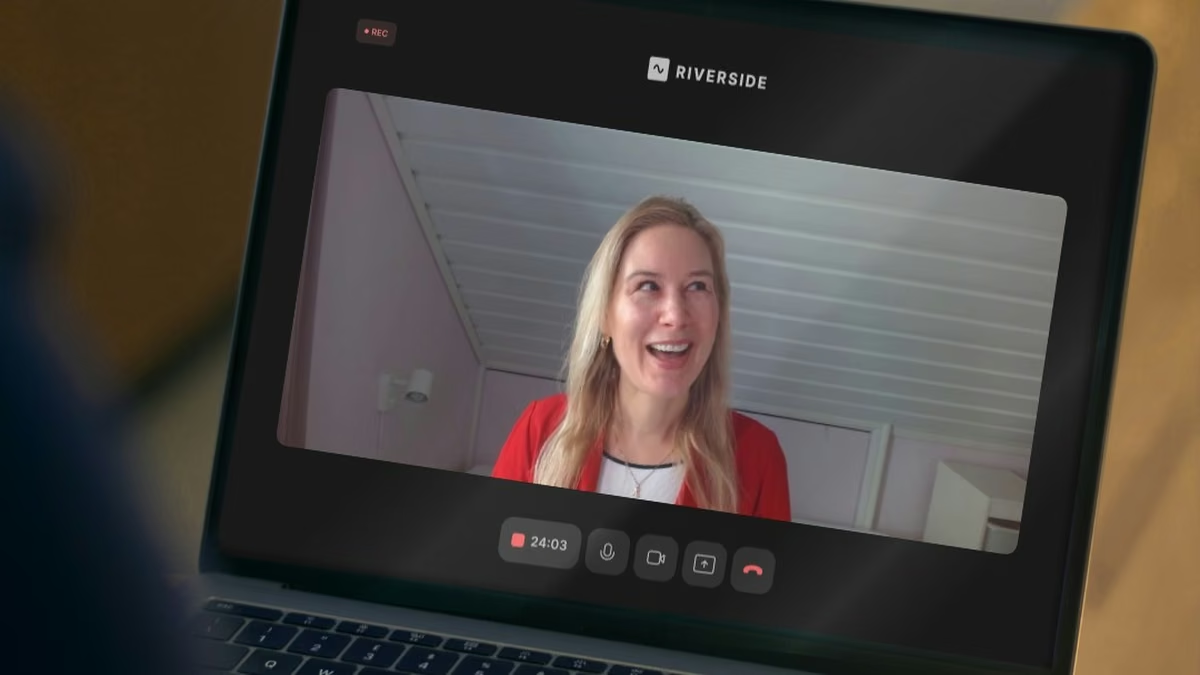
The production stack evolved. I started with a basic microphone and grew into a Shure SM7B, which I've been on for the last five-plus years. Through several Rodecaster generations. Currently recording on Riverside.fm, which I've been quietly shooting video on for four or five years without publishing it - that footage will start seeing daylight on the next show.
Behind the scenes, this was always a multicultural, multi-geography team:
- Liezelle, based in Canada, was my master of scheduling. She coordinated guest invites, managed the recording pipeline, briefed editors, and held the whole production together. She is one of the reasons this run was sustainable.
- Joshua, based in Africa, did all the episode artwork - the cover images, the headshot integrations, the visual identity that ran across hundreds of episodes.
- Michael, Vladimir and Riche, distributed across multiple geographies. Each show had its own editor specialised to its rhythm and sound.
I batched recordings into the first Tuesday, Wednesday, and Thursday of every month. Up to six episodes in a single day. By the end of those three days I was absolutely drained - but the rest of the month was clear, which is the only way I sustained this alongside everything else.
The flywheel#
The podcast didn't exist in isolation. Over its run, it became the centre of a wheel that spun outward into other things.
The 90 Day Mentoring Challenge, which has now had over 1,500 participants from more than 70 countries, fed guests into the podcast. The podcast fed credibility back into the Challenge. More than 65 Mentoring Challenge participants have gone on to receive the Microsoft MVP award - a number I'm prouder of than any download figure.
The Microsoft 365 Copilot Adoption book, co-authored with my partner Meg and published by Microsoft Press, came out of the podcast directly. Episode after episode, talking to Microsoft people about the same thing - adoption is the actual open - eventually I couldn't ignore that the pattern needed a book around it.
My continuous Microsoft AI Platform MVP status since 2012 opened doors for the show. The show, in turn, kept the MVP work visible. They reinforced each other.
Underneath all of it was one thing: a curiosity mindset. Always looking, always searching for what was coming next, then asking - "how does this apply to me and what I'm doing: " The podcast gave me the ability to learn from hundreds of people much smarter than me, and apply what I learned almost immediately to my own work.
What I got wrong, and what I got right#
I've made plenty of confident statements on this show over nine years. The most famous was at a conference in Amsterdam where I declared "Dynamics 365 is dead."
It became a meme. What people quoted less often was the second half of the sentence: "…long live the Power Platform." My actual point was that Power Platform had become the underlying technology of the Dynamics 365 suite, and the smart money was to think of it that way. That call has aged extremely well.
My current prediction, on the record: low code is going away. It's going to be replaced entirely by AI-driven code. Configuring low code takes too long. Commit to the CLI, and let AI do the heavy lifting. Talk to me in two years.
As for predictions that aged badly - honestly, I can't think of one. The whole stack the podcast covered is in a massive state of flux right now, and AI's impact on Dynamics 365 and Power Platform is going to be phenomenal. The bets the show made aged well.
Why now#
I'm wrapping up because my career has moved on.
Low code is no longer my focus. The Intelligence Age is. There is, in my view, a massive upside to where AI is taking the world of work, and I want to be all-in on it. That meant drawing a line under a great run and freeing up the bandwidth to take on new projects, new ideas, new shows.
This isn't a sad goodbye. It's a thank you and a next.
What's coming#
The Microsoft Innovation Podcast wraps with Episode 836 on 28 May 2026 - "Why AI Adoption Fails and How to Fix It".
Almost immediately after, I'm launching ** The Intelligence Age Podcast ** - a single-show, single-format successor focused on practical AI for the Intelligence Age. Audio and video this time, by default. Different posture, different cadence, but the same curiosity at the core. Skill over knowledge - that's the editorial north star.
If you've been part of the MIP audience, the Intelligence Age Podcast is where I'd love you to follow me next.
Thank you#
To Liezele, my producer - for nine years of holding the production together with extraordinary care. To the artwork lead in Africa and the per-show editor team - every episode looked and sounded the way it did because of your work. To Andrew Welsh, Chris Huntingford, Ana Welsh, and Will Dorrington - for trusting me with the Ecosystems Show and making the panel format something I genuinely loved. To Joel Lindstrom, Gus Gonzalez, and George Doubinski - for showing me what good podcasting looked like before I started. To Meg, my partner in everything - for backing this from the beginning, co-authoring the book, and putting up with three days of recording every month for nearly a decade. To James Phillips, Charles Lamanna, Ryan Cunningham, Steven Siciliano, and the many other Microsoft leaders who said yes when I had no business asking. To Buzzsprout - the platform that hosted every single one of these episodes. And to the 800-plus guests who said yes - your stories are the reason any of this exists.
Most of all, to the listeners. Half a million downloads is a number. The conversations that came out of those downloads - the comments on YouTube, the messages on LinkedIn, the families who asked for episodes of their loved ones - those are why I kept showing up.
The line I want to leave you on#
It's been an absolutely fun journey. I've learned more than I can measure, watched the industry change in ways I couldn't have predicted, and had the privilege of recording front-row seats to almost a decade of technology evolution.
There's never been a better time to be alive if you're in tech. The opportunities are literally unprecedented.
That's why I'm pivoting. That's why I'm taking the lessons from 800-plus episodes into the next thing. And that's why this isn't a goodbye - it's a see you on the other side.
Thanks for listening.
Mark Smith is Principal AI Strategist at Cloverbase. To discuss this article or work with me, contact me at Cloverbase.

Mark Smith
Principal AI Counsel · Microsoft AI MVP
Helping people build practical AI skill in the Intelligence Age.
More from nz365guy
Microsoft Business Applications Podcast – Lessons Learned
My podcasting evolution from when I started. Nottingham, England budging free bed and board from my cousin and I had managed to schedule a time to speak with Guus...
My First Live Stream Event on YouTube
Live streaming at Microsoft Business Applications Summit Atlanta 2019. I was chatting with my buddy Steve Mordue months leading up to the Microsoft Business...
Richard Dickinson – Product Management at Microsoft
Mobility is beyond the new normal.
Discussion
Comments
Loading the discussion for this post.
Leave a comment
Your email stays private. If it matches a Gravatar account, your public avatar can appear after the comment is approved.